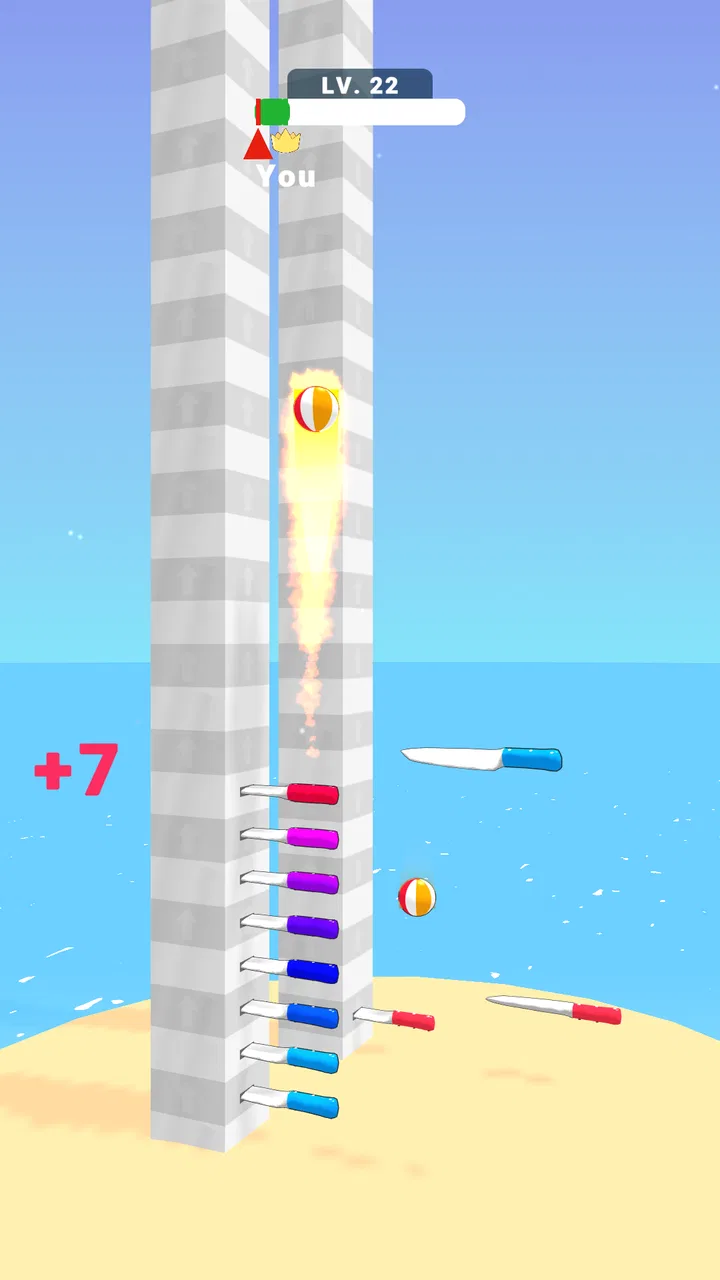
Ball Up: Knife Racing
- 4.4
- Rating
- 10.00M
- Installs
- Free
- Price

 Analysis by App-foxy
I spent time with Ball Up: Knife Racing as a quick action game built around a very simple objective: guide a ball toward its goal while reacting to what appears in front of you. That simplicity is the main attraction. I can open it without learning a complicated control scheme, play for a short break, and understand almost immediately whether I am improving or merely rushing.
It comes from VOODOO, a developer known for compact mobile games, and it fits that pick-up-and-play style closely. The game is free to download, rated for Everyone, and has reached over ten million installs. Those figures suggest that its basic idea is easy for a broad audience to understand, but popularity alone does not make every short-session game worth keeping. What matters here is whether the small amount of interaction stays satisfying after the first few attempts.
My answer is mixed but positive: this is best approached as a lightweight reflex game rather than a deep racing experience. It can be a good choice when I want immediate action, but it is not the right replacement for a larger racing game, a story-driven adventure, or anything built around long-term strategy. The appeal is in the short burst, the quick restart, and the challenge of becoming more consistent.
You May Also Like

 Blood Strike: 2.5 Anniversary
Blood Strike’s Loadouts Turn Every Drop Into a Tactical Gamble
A close look at Blood Strike’s custom loadouts: how fast access to signature weapons reshapes its battle royale rhythm, rewards preparation, and narrows the gap between fights.

 Pandora - Music & Podcasts
Pandora’s Music Is Easy to Start, but Harder to Recover
Pandora’s strength is its low-effort path from a seed to a station. Its weak spot is how much confidence it asks you to place in connection, setup, and quiet recovery.

 8 Ball Pool
 Is Built on Rivalries, Rematches, and Routine
A close look at the rivalries, rematches, shared routines, and unanswered safety questions that turn a quick pool match into a persistent mobile community.

 Samsung Music
’s Quiet Strength Is Playing What You Already Own
Its reach comes less from spectacle than from dependable access to a personal library. That simplicity is both the app’s strongest retention engine and its ceiling.

 AccuWeather: Weather Radar
AccuWeather Review: A Quick, Clear Forecast for Everyday Decisions
For everyday plans, the best forecast is the one you can understand quickly. AccuWeather makes rain timing, radar, and local conditions easy to act on, with a few trade-offs.

 Hill Climb Racing
Why Hill Climb Racing Still Turns Crashes Into One More Run
A tiny car, a bumpy hill and one more upgrade: Hill Climb Racing keeps resurfacing because its simple chaos makes every near-miss feel personal.
More From Our News Desk



How the speed feels when the game gets demanding
The first thing I notice is that the game’s sense of speed comes less from a complicated simulation and more from how quickly I need to make decisions. A ball moving toward a goal sounds harmless, yet the timing becomes the real test. I have to look ahead, avoid reacting too late, and resist making a correction simply because the screen feels busy.
That creates a useful distinction between visual speed and practical speed. The action may look straightforward, but a small mistake can happen quickly enough that I need to stay focused. I would not describe the experience as a realistic racing model. It is closer to an arcade reflex exercise, where success depends on reading the route and keeping my input controlled.
This is where the “Knife Racing” part of the name sets an expectation that the game may feel more tense than a basic ball-rolling toy. I approached it expecting sharp timing rather than a leisurely puzzle, and that made the short attempts easier to appreciate. If you prefer games that let you plan every move slowly, the pace may feel unforgiving. If you enjoy testing reactions in compact rounds, the pressure is more appealing.
One practical tip helped me more than simply trying to move faster: I started treating each attempt as a lesson in rhythm. Instead of staring only at the ball, I watched the space immediately ahead and prepared my next correction before the current one was finished. That reduced the repeated oversteering that often causes a failed run. It is a small change, but it turns the game from random tapping into a more deliberate skill test.
Why short sessions work better than marathon play
The design makes the most sense in brief sessions. I can use it while waiting for an appointment, during a short commute break, or when I want something more active than scrolling but do not have time to settle into a full game. A typical everyday use case is opening it for a few attempts, focusing hard for several minutes, then putting the phone away without feeling that I have abandoned a complicated campaign.
That convenience also exposes the game’s limitation. Repeating similar reflex challenges for a long period can become tiring, especially if I am not in the mood to chase better performance. The same directness that makes the first session accessible can make extended play feel narrow. I would keep it alongside other games rather than expect it to be my only source of entertainment.
There is also a difference between frustration and useful difficulty. When I fail because I rushed a turn or misread the route, I usually feel that another attempt could fix the problem. When I am tired, however, the same demand becomes less enjoyable. My best results came when I played with a clear screen and a few uninterrupted minutes, not when I tried to squeeze in attempts while distracted.
What happens during heavier use
For a small action game, the important question is not only how it starts but how it behaves after repeated restarts. I found the restart-friendly structure more valuable than a long loading sequence would have been. Quick attempts suit the game’s purpose, because a failed run does not need to become a major interruption to my day.
Heavy use can mean different things here. It may be several attempts in a row, switching rapidly between the game and another app, or playing while the device is already handling other tasks. I would not treat a short arcade title as a demanding benchmark for a phone, but I would still pay attention to whether the device begins to feel warm, whether the battery drops faster than expected, or whether input becomes less comfortable after repeated play.
The sensible approach is to keep expectations moderate. Ball Up: Knife Racing is designed around immediate action, not around a large world that needs to remain active for hours. That should make it a more natural fit for casual use than for continuous all-day play. If I were choosing a game specifically to test a new phone’s graphics power, I would look elsewhere. If I wanted something that could occupy several short gaps in the day, its compact format would be more appropriate.
A second useful habit is to avoid judging the controls during a distracted session. Because the game depends on timing, a notification, a cramped grip, or a finger placed slightly differently can feel like a performance problem when the real issue is attention. I found it better to play with the phone held securely and the screen unobstructed. That does not transform the game, but it makes the result more consistent.
Stability, recovery, and the cost of a failed attempt
Reliability matters especially in a game built around short runs. If I open it for a quick break, I want the transition into play to feel uncomplicated. The game’s simple premise helps here because I do not need to remember a complex control layout or reconstruct a long quest after returning.
Recovery is also part of the experience. A good casual game lets me fail, understand roughly why, and try again without turning the mistake into a major penalty. That loop is central to the appeal here. I can use a failed attempt to adjust my timing immediately instead of waiting for a later chapter or collecting a long list of upgrades before I have another chance.
That does not mean every return will feel equally smooth on every phone. Device age, available storage, background activity, and the version of the operating system can all affect how any mobile game behaves. The practical compatibility floor is Android 8.0, so anyone using an older Android device should check that requirement before expecting to install it. On supported hardware, I would still keep the usual mobile habits: close unnecessary background tasks if the phone is struggling, keep the system updated, and avoid playing while the device is already overheated.
The current version is 2.4, which is useful context for anyone comparing an older installation with the present release. I would update before making a final judgment, particularly if the game seems to behave differently from what I remember. A version change can affect feel and stability, and casual games are easy to dismiss when the real problem is simply an outdated build.
Device limits and the trade-off of free access
The game is free, which lowers the barrier to trying it. I can install it without making an upfront purchase and decide for myself whether the short-session loop fits my habits. That is a strong advantage for a game whose appeal depends heavily on personal tolerance for repetition and reflex pressure.
Free access does not mean there is no commercial friction. In-app purchases range from $0.99 to $6.99 per item. I would treat those purchases as optional spending rather than part of the core reason to install the game. Anyone who dislikes seeing purchase prompts in free games should pay attention during the first session and use the device’s purchase controls if children may be playing.
The Everyone rating makes it suitable for a broad age range, but suitability is not the same as universal enjoyment. Younger players may understand the objective quickly, while adults who want a substantial racing system may find the experience too light. The age rating tells me the content is broadly accessible; it does not promise that the challenge will be gentle or that every player will enjoy repeating attempts.
On the hardware side, I would choose it for a phone that handles ordinary mobile use comfortably, not as a guaranteed solution for an older or heavily constrained device. The game’s compact action format suggests a lighter commitment than a visually expansive 3D racer, yet I would not invent a precise battery or memory claim. The honest expectation is simply that supported devices should be the starting point, with actual comfort depending on the phone and what else is running.
One overlooked trade-off is screen size. A larger display can make the route easier to read and the controls more comfortable, but it may also make one-handed play less convenient. A smaller phone is easier to hold during a quick break, while a cramped screen can make precise reactions harder. I would not choose a device for this game alone, but I would remember that control comfort can matter more than raw specifications in a reflex title.
Where it fits among other action games
Compared with a conventional racing game, Ball Up: Knife Racing is much more immediate and much less ambitious. Traditional racers usually give me vehicles, tracks, speed management, and a broader sense of progression. Here, the focus is narrowed to guiding the ball and responding correctly. That makes it easier to start, but it also means there is less room for players who want customization, exploration, or a long career structure.
Compared with a puzzle game, it asks for faster reactions and less patient planning. I cannot rely entirely on studying a board before acting. Compared with an endless runner, the appeal is not simply surviving as long as possible while moving forward; the goal-oriented structure gives each attempt a clearer destination. These comparisons help explain its audience: it sits between reflex action and compact route challenge rather than fully belonging to a large racing genre.
I would recommend it to someone who likes mobile games that can be understood in seconds and improved through repetition. It is also a reasonable option for a child or casual player who wants a direct action game with an Everyone rating, provided an adult is comfortable with the presence of optional purchases. I would skip it if I need a strong narrative, online competition, deep progression, or a game that rewards long strategic planning.
Another situation where I would choose a different option is a long journey with no reliable opportunity to stop. A deeper game may hold attention better over an extended period, while this one is more naturally divided into small bursts. Likewise, if I am already irritated by precision-based games, the quick-failure loop may feel more stressful than relaxing. Its value depends on wanting a focused challenge, not merely wanting something free.
What I would do before recommending it
Before installing, I would check that the phone runs Android 8.0 or later and that there is enough room for another game. I would also decide whether the device is mainly being used for short breaks or for extended play. That simple decision prevents a common mismatch: expecting a compact arcade title to provide the depth of a full racing game.
After opening it, I would give the controls several honest attempts rather than judging the whole experience after one mistake. The early learning curve is about restraint. I would focus on making smaller corrections, looking ahead, and noticing whether failure feels fair enough to invite another try. If that loop feels satisfying, the game has probably found its audience in me.
I would also keep purchase expectations clear. The free entry point is useful, but I would not spend money simply because I had a frustrating run. If an optional item appears tempting, I would first ask whether it changes the kind of play I enjoy or merely shortens a challenge I might otherwise learn through practice. That distinction is especially important in a game whose main reward is improving my own timing.
My performance verdict
Ball Up: Knife Racing works best as a focused, low-commitment action game. Its strongest qualities are the direct objective, the quick attempt structure, and the way a simple ball-and-goal idea can demand more attention than it initially appears to. I like that I can return after a failed run and immediately apply a small adjustment instead of waiting through a long recovery process.
Its weaknesses are equally clear. The narrow format may not sustain players who need variety, story, or a substantial progression system. The reflex emphasis can feel tiring when I am distracted, and the free model includes in-app purchases from $0.99 to $6.99 per item. I would also avoid making broad claims about battery life or device performance without testing the exact phone in question; the Android 8.0 requirement is the practical compatibility point to check first.
With an average rating of 4.4 from around thirty-five thousand ratings and roughly one thousand eight hundred written reviews, the reception is strong enough to make a trial feel reasonable, while the install total of over ten million shows that the format has broad reach. I would not use those figures as a substitute for personal taste, but they fit my impression that the game is easy to approach even if it will not satisfy everyone for long.
My recommendation is simple: try it if you want a free action game for short, alert sessions and enjoy improving through repeated attempts. Skip it if your idea of racing involves detailed cars, expansive tracks, or a long-term campaign. For the right player, it is a neat little test of timing. For everyone else, its simplicity may become the very reason it gets removed after a few days.
FAQs for Ball Up: Knife Racing
01What is the objective of Ball Up: Knife Racing?
In Ball Up: Knife Racing, the main objective is to skillfully navigate a knife through an obstacle-laden path by tapping the screen. Players must maintain a rhythm to keep the knife moving upward while avoiding obstacles and collecting rewards. The game combines elements of timing and strategy to achieve high scores.
02Is Ball Up: Knife Racing free to play?
Yes, Ball Up: Knife Racing is free to download and play. However, it offers in-app purchases that enhance the gaming experience. These purchases can include removing ads or buying additional in-game currency to unlock special knives and power-ups. Players can enjoy the game without spending money, but purchases can provide additional benefits.
03What are the system requirements for Ball Up: Knife Racing?
Ball Up: Knife Racing is designed to run smoothly on most modern Android and iOS devices. For optimal performance, it is recommended to have a device running Android 5.0 or later, or iOS 11.0 or later. The game is lightweight, ensuring compatibility with a wide range of smartphones and tablets.
04How do I control the knife in Ball Up: Knife Racing?
Controlling the knife in Ball Up: Knife Racing is intuitive and simple. Players tap the screen to flick the knife upward. The key is to time the taps accurately to navigate through obstacles and maintain the upward momentum. Precision and timing are crucial to achieving high scores and progressing through levels.
05Are there any social features in Ball Up: Knife Racing?
Yes, Ball Up: Knife Racing includes several social features. Players can connect with friends to compete on leaderboards, share their achievements, and challenge others. The game encourages a competitive environment where players can showcase their skills and strive for the highest scores among their peers.
Pros
- Engaging gameplay with intuitive controls.
- Vibrant graphics enhance the user experience.
- Challenging levels keep players hooked.
- Frequent updates with new features.
- Smooth performance on most devices.
Cons
- Contains ads that can disrupt gameplay.
- Limited free content
- with in-app purchases.
- Can be repetitive after extended play.
- Requires internet connection for some features.
- Some levels may be too difficult for beginners.

Ball Up: Knife Racing
Gallery